• Skip to primary navigation
  • Skip to main content
Dr.Peter-Holsman_vertical.svg
  • About
    • About Me
    • Your Consultation
  • Conditions
    • Digestive Problems
    • Hormone Imbalance
    • Stress + Mood
  • Services
    • Integrative Medicine
    • Natural Supplements
    • Specialised Tests
  • Resources
    • Articles
    • Videos
  • Contact
  • Book Your Appointment
  • About
    • About Me
    • Your Consultation
  • Conditions
    • Digestive Problems
    • Hormone Imbalance
    • Stress + Mood
  • Services
    • Integrative Medicine
    • Natural Supplements
    • Specialised Tests
  • Resources
    • Articles
    • Videos
  • Contact
  • Book Your Appointment
Search
Close
  • About
    • About Me
    • Your Consultation
  • Conditions
    • Digestive Problems
    • Hormone Imbalance
    • Stress + Mood
  • Services
    • Integrative Medicine
    • Natural Supplements
    • Specialised Tests
  • Resources
    • Articles
    • Videos
  • Contact
  • Book Your Appointment

Stress

Feeling out of control is a common emotion in these unsettling Covid-19 times. Find out what you can do to boost your energy, mood and resilience.

Anxiety and fear are common in many of my patients as a result of the current Covid-19 Pandemic. The reality is that social isolation is disrupting people’s families, careers, hobbies, exercise and of course holidays.

This article will introduce you to some strategies that will help you better manage emotional stresses in these difficult times.

What Some Of My Patients Are Saying

  • I am afraid I will get the virus
  • I cannot handle being in isolation
  • My elderly parents might get the virus
  • I cannot visit my friends or family.

The list is actually a lot longer and the odds are that you can add a few more items  to these concerns.

There Are Many Things We Cannot Control

  • Whether other people follow the social distancing rules
  • How long the pandemic will last
  • The amount of toilet paper in supermarkets.

My advice is that you may feel more relaxed when you accept that some, perhaps many things, are not in your control. You can then let them go and focus on what you can control. Which brings me to some things that you can control.

What You Can Control

There are some areas of your life that you can control. It is really important to take steps that will protect your emotional and physical health, as well as support your sense of purpose and connection.

Make A List Of Activities You Can Do Now

  •  Physical distancing
  • Limiting social media
  • Turning off the news
  • Finding fun things to do at home
  • Going for a walk
  • Connecting with friends and family

See how many other activities you can add to this list.

Putting Pen To Paper

Begin your day by putting pen to paper. What do you plan to accomplish? This helps create a sense of purpose so that you feel empowered. Some days it may be as simple as making your bed, remembering to brush your teeth or getting dressed for your “home office”. On other days – preferably most- you may have multiple items and a super productive day.

Some reflection in the evening can also be helpful. Questions may include:‍

  • What am I grateful for today?
  • Who am I checking in on or connecting with today?
  • Did I get outside today?

How Are You Feeling Emotionally?

Common underlying emotions in people I meet include anxiety, fear, panic, anger and sadness. It can be helpful to ask yourself what is behind or underlying these feelings. Understanding why you have these feelings can lead to powerful and helpful insights into your responses.

What Are You Thinking?

A common theme in counselling patients is that there is a lot of negative self -talk and negative beliefs. The following five negative beliefs are from the book “Eye Movement Desensitisation and Reprocessing (EMDR) Therapy” by the late Dr Francine Shapiro.

  • I am not in control
  • I am helpless
  • I am powerless
  • I cannot handle this
  • I am insignificant

There are times that negative thoughts are new and only in response to the Covid-19 pandemic. However for some people, these limiting beliefs have been present for many years, often going back to early childhood. As such, they can be holding you back in other areas of your life, and are best resolved with therapy.

What Beliefs Will Serve You Better?

Imagine how much calmer you will feel when negative self-talk or beliefs lose their emotional charge and are replaced with positive beliefs such as in the following list:

  • I can handle it.
  • I can learn to deal with this.
  • I am at peace with myself
  • I have options within the framework that I am now living
  • Being alone is being in control of preventing myself from being infected or infecting others.

What This Means To You

Everyone has choices in how they respond to the current disruptive Covid-19 Pandemic. Counselling with me or a psychologist of your choice is readily available if you are feeling emotionally overwhelmed or “stuck”.

There are many different counselling techniques including Cognitive Behavioural Therapy (CBT), hypnotherapy, Internal Family Systems (IFS), Ego State or Parts therapy and Eye Movement Desensitisation and Reprocessing (EMDR) Therapy.

All are valuable and a skilled therapist will offer what works best for each person.

The best time to act is now so that you can resolve unsettling emotions or unhelpful beliefs that are causing you to feel anxious, frustrated or otherwise “stuck”.

Telehealth Consultations

Telehealth is the new way for many consultations. You are welcome to send me an email or phone the clinic to book an appointment.
How to boost your ability to manage difficult people or situations in this blog…

A lady saw me with a history of frequent headaches.  She was drinking plenty of water, so dehydration was not the problem. It turned out that the headaches were triggered each time she had contact with her mother.

Communication and relationships are a huge topic. I advise at least one person everyday who is having trouble with relationships.   Relationships – whether with family, friends or work colleagues – can definitely be challenging.

Mind reading has been tried by many people. Effectively they hope that the other person will read their mind and change their behaviour so they will then be happy. Does it work? I am still waiting to hear of a successful result!

Clues that you may be having trouble getting your message across.

  • Poor sleep
  • Anxiety
  • Craving chocolate or lollies?
  • Feeling frustrated?
  • Fatigue
  • Want to run away or lie on a couch
  • Bloating, constipation, back pain, headaches

Yes, there are also a lot of physical causes that need to be ruled out. The bottom line is that emotional stress is often a trigger or contributor for the above symptoms.

Here are some of my thoughts and general advice.

Boundaries.

Healthy boundaries preserve our integrity and filter out harm. How good are you at setting and protecting your personal boundaries? Have you walked away from a conversation, meeting, or visit feeling violated and not understood?

Once again I recommend that you get a copy of “Where to Draw the Line” by Anne Katherine. It is a practical guide to establishing and maintaining healthy boundaries in many different situations.  Topics covered include friendships, sexual relationships, dress and appearance, time management, money and food. Her book offers skills and strategies that will help you make choices that balance your own needs with the needs of others.

Time Frames

Quite a few people have told me about difficult friendships or relationships that have gone on for years. The results have included low confidence, low self- esteem and exhaustion. Work out how long you are willing to put in the time and effort to sort out stressful people and situations. Ideally you will be making progress within six to twelve months. The exception is where a relationship is unsafe and needs to be ended quickly.

Neutral Ground

Meet on neutral ground when discussions at home result in frustration. Meet your friend or relative in a public place such as a café. People tend to stand their ground in the safety of their own home and avoid reviewing their opinions. Thus behaviour is more likely to be relatively polite and flexible in a public area.

Assertive Skills

Assertive skills make a huge difference to how you get on with others. This is where you choose words that say how you feel about or see a concern. For example, “I feel uncomfortable when… “ is a non- threatening way of speaking. Pointing your finger and saying that “You are a pain in the…” or “It’s your fault that…” is guaranteed to put the other person on the defensive and escalate conflict.

Protect the Young and Innocent

Protect your children. Avoid involving your children when you are unhappy with a partner. Lots of people tell me of emotional scars from their childhood as a result of getting drawn into, or trying to fix parental arguments. Some of these children have grown up to realise that they have spent the rest of their lives attempting to please, fix and rescue others.

Having the Last Word

Some people have a pattern of always wanting to have the last word and finish the discussion. How do you think the other person will feel or respond? Will they feel resentful or controlled? You may need to let the other person have the last word. Perhaps one or both of you need some time to think about your options and can revisit them in a day or two.

I Will Get back To You

I will get back to you. Children are masters at wanting something NOW. Some adults are no different. “I will get back to you when…” is a really useful phrase. It is empowering and there are many times that you will benefit from some extra time to come up with the best decision.

What Else Can You Do To Boost Your Communication, Mood and Emotions?

Make an appointment to see me, a counsellor or psychologist to give you independent advice, skills and strategies to improve your communication skills and review how you manage your boundaries. As is often said – If you do the same thing over and over again, you will get the same results over and over again. There is a limit to what most people can achieve by themselves.

Those who know me well, will be aware that journaling, appropriate exercise and food choices are an expected part of my holistic approach to boosting communication skills, energy and resilience.

Enjoy a healthy life,

Dr Pete

Gratitude is a great way to help you become more resilient and adaptable in times of stress

New YouTube video

https://www.youtube.com/watch?v=wJx2QWcd8nc&t=3s

Covid-19 has caused many of my patients to feel anxious, fearful and otherwise unsettled.  This YouTube video will help you to better understand and emotions, self-talk and beliefs.

You are welcome to share this video with family and friends. I look forward to any comments, as well as suggestions for future videos on such topics as fatigue related illness, gut problems and challenges with stress, anxiety and depression.

Practising gratitude has many benefits.

You can feel a lot better when you become aware of the good things that have happened during the day.

Here are some questions that you can ask yourself at the end of each day. They can be answered during the evening meal with family or at bedtime. Just before bed, our mind is very receptive. And no matter what we may have been worried about or what went wrong during the day, we have the chance to let good feelings ease us into sleep.

Here are seven great questions: Today what was the best thing…

  1. 1. I saw.
  2. 2. I ate.
  3. 3. I did for me.
  4. 4. I did for someone else.
  5. 5. I received.
  6. 6. I found funny.
  7. 7. I learned.

Patients tell me that this gratitude practice has helped them develop a more positive focus and that they are making more of an effort to be thankful and appreciative.

I look forward to every Friday because the “Friday Funnies” arrive in my inbox. This week’s edition included a very thoughtful piece about the world’s current situation by Patricia Cameron-Hill. I believe it is relevant to all adults and her thoughts are quoted below.

Messages for ‘olders’ to better manage the current crisis.

We ‘Olders’ are considered to be the most vulnerable to Coronavirus. This puts us in a unique position to be a good example to young people who may be anxious about themselves and us. We have a chance to help them cultivate positive attitudes, positive emotions and helpful behaviours.

None of us want to die, but we know that our lives are given to us with no guarantee of physical safety and we have to accept that. This reality can be easier to accept with the experience and wisdom that comes with age.

The Impact of Anxiety and Fear

It may be helpful to understand that the real problem we have to manage during this crisis is fear. Fear comes with anxiety, and if we can manage that, then we can make better decisions and take steps to not only survive Coronavirus, but to learn and grow from the experience.

Some people may not recognise their own anxiety and behave irrationally (panic buying) or destructively without realising that anxiety is driving their behaviour. Those who are aware can be at a loss to know what to do about it.

There is something we can do…

Francis Macnab (psychotherapist & former minister of St Michael’s) uses a helpful analogy. He says that being anxious is, “Like dogs running loose in the backyard, running in all directions and out of control”. When faced with anxiety we must “Tie up the dogs and stay steady.”

It’s not always easy to do this, but it is a helpful image to keep in mind as we look for ways to stay steady: For example, using the breath to relax, accessing calming influences, limiting our exposure to bad news, enjoying music, dancing and walking.

Inner Strength and Resilience

We can have faith in ourselves to draw on our inner strengths. We have lived long enough to know about chaos and unwanted events and for the most part, our ability to get past them. It is the meaning we choose to give to a crisis situation that will determine our feelings and our response. We know we cannot always control what happens, but we can control the way we see things. This is achieved by using the power of our mind to override the biological reaction of fear, panic and anxiety.

This edition of the Friday Funnies can remind us of the importance of a sense of humour and laughter. Laughter helps us to put aside a threatening future and live in the present. When we live in the present we may be aware of our stressful circumstances, but we also know our capacity as human beings to handle them.

We are equal to the challenge of this crisis. We have what it takes to stay steady, keep our dignity and be confident – to be our best selves.

Laughter is the Best Medicine

I have been enjoying the Friday Funnies for many years since meeting Patricia and Shayne at a National speakers Association of Australia meeting where they presented on stress and humour.

You Too Can Enjoy the Friday Funnies. Here is a link where current subscribers can refer a friend:

http://us2.forward-to-friend.com/forward?u=97712ae11acffb4f840e58876&id=140644c2c3&e=2372c28949

YouTube is another great source of comedy as well as inspiring talks. My favourite comedian is Michael McIntyre.

What This Means To You

The level of anxiety and fear am seeing in the streets as well as in the clinic is palpable. Your immune system will thank you for adding some balance and hence strength with an added dose of humour.

Telehealth Has Arrived

Telehealth is a new way for medical consultations. This is to minimise the risk to our staff, other patients and yourself. Consultations in the clinic are still available when clinically appropriate.

Stay Healthy,

Dr Pete

Methylation is the process of activating a molecule through the addition of a methyl group (CH3). Genetic MTHFR mutations are one cause of potential reduced methylation function. Methylation is important in numerous biochemical and metabolic reactions, acting as an “on/off switch”. Relevant functions include energy production, regulation of gene expression, brain function, mood, hormones and detoxification.

Methylation

Methylation is the process of activating a molecule through the addition of a methyl group (CH3). Genetic MTHFR mutations are one cause of potential reduced methylation function. Methylation is important in numerous biochemical and metabolic reactions, acting as an “on/off switch”. Relevant functions include:

1 Energy production

2 Regulation of gene expression

3 Brain function

4 Healthy cell membranes (phospholipids)

5 Neurotransmitters such as serotonin, melatonin, dopamine and norepinephrine

6 Hormone (particularly oestrogen) metabolism

7 Liver function (glutathione metabolism)

Methylation and MTHFR

A mutation in the MTHFR gene could result in defective or insufficient MTHFR enzyme, which may affect methylation. This in turn can result in a decrease in methylation, leading to a lack of active folate and folate conversion.

The Methylation cycle

The methylation cycle has many complex steps and I am happy to explain diagrams in your consultation.

In the folate cycle, tetrahydrofolate (THF) gets converted to 5-methyl tetrahydrofolate (5-MTHF), the most abundant form of folate in human body.

The folate cycle connects to its partner, the methionine cycle, through the next step, where 5-MTHF donates its methyl group via the vitamin B12 dependant enzyme, methionine synthase, to remethylate homocysteine back to methionine

What if I have a mutation in the MTHFR gene?

While it is important to know if you have a gene mutation, it doesn’t mean that you will have any issues. However, in practice, patients seeing me who have severe chronic disease, anxiety or depression are more likely to be experiencing problems due to the expression of gene mutations.

It is also important to avoid focussing all your efforts on “fixing” one biochemical pathway or compensating for a single gene mutation. A holistic treatment plan needs to address all the other areas of your health and lifestyle. These include digestion, hormones, sleep, nutrition, exercise, environmental toxicity, stress management, work and relationships.

How can I check for this gene?

There are two ways:

1 Ask me for a referral for an MTHFR gene test.

2 You can do a more extensive DNA test.

Dr Peter Holsman is a qualified medical general practitioner and naturopath who specialises in functional and integrative medicine.

Adrenal Fatigue Treatment, Symptoms and Stages of Adrenal Fatigue

Your adrenal hormone glands help you deal with stress. Symptoms of adrenal fatigue may include fatigue, unstable blood sugar levels, decreased libido, body aches, depression, digestive problems, sleeping difficulties, blood pressure changes, irritability, loss of appetite, menstrual irregularities, nervousness, weight gain, and feeling cold. Keep reading for the full story…


Symptoms of Adrenal Fatigue

Your adrenal hormone glands help you deal with stress. So, what happens when your adrenal glands stop working well?

Symptoms may include fatigue, unstable blood sugar levels, decreased libido, body aches, depression, digestive problems, sleeping difficulties, blood pressure changes, heart palpitations, hyperventilation, irritability, loss of appetite, menstrual irregularities, nervousness, weight gain and feeling cold.


Adrenal Fatigue Tests

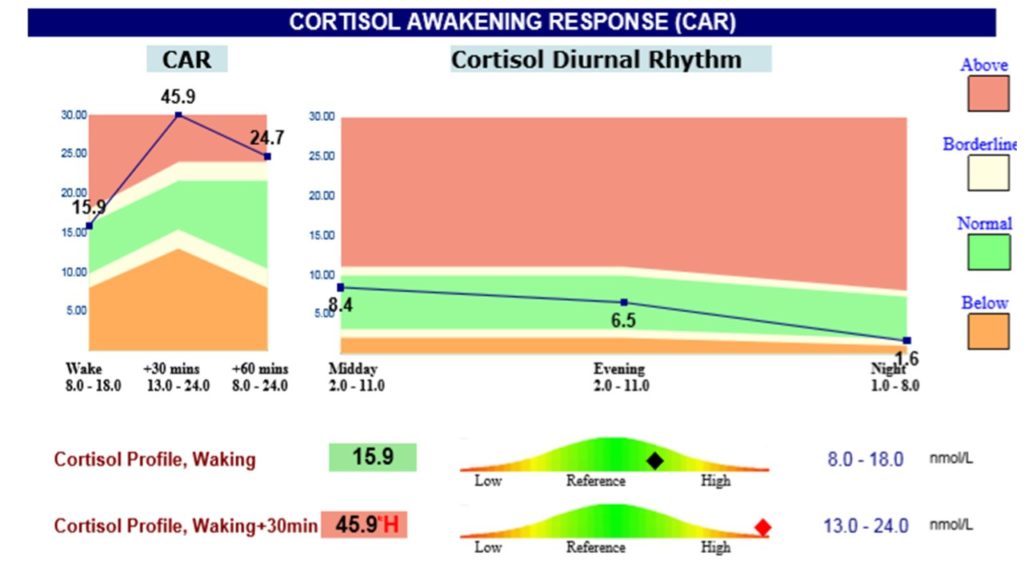
My preferred test is a saliva cortisol panel with samples taken over a 12 hour period.
Thyroid function and iron studies will generally be checked as well because they are also significant causes of fatigue.

‍Have a look at the Saliva Cortisol Results here below. This patient wakes up feeling anxious. You can see that the cortisol level surges in the first thirty minutes, consistent with what she anticipates in the day ahead.

adrenal fatigue treatment and cortisol

‍
Why is she stressed?

There are lots of possibilities. Relevant questions on seeing results like this will cover stresses with work, relationships, the quality of sleep, infections and gut health.


What Do Your Adrenal Glands Do?

Your adrenal glands are the size of a walnut and sit on top of each of your kidneys where they make and secrete steroid hormones such as cortisol, estrogen, DHEA and testosterone that are essential for life, health and energy. They influence the function of every tissue, organ and gland in your body to keep you going during times of stress.


The Fight or Flight Response

Your adrenal glands function to help you fight off danger or run away and escape – the fight or flight response.

In a more primitive hunter gatherer society that would mean being able to run away quickly, fight or pursue an enemy or food, endure long periods of physical challenge and deprivation, and store up physical reserves when they are available. One way or another, the stress was over in a short amount of time.

Challenges of Modern Day Life

Modern society is different in that stresses tend to be chronic and last a long time. It may be that you are battling a difficult boss, air pollution, family arguments, financial problems, poor quality sleep, infections or food allergies or sensitivities.

Stages of Adrenal fatigue

Stage 1: Alarm Reaction

During this initial stage of stress, your body responds to stress by making more cortisol and DHEA hormones. Fatigue is generally quite mild and usually occurs in the morning upon awakening or in mid afternoon. People often turn to coffee, caffeinated sodas, energy shots, chocolate, or sugary, high-carbohydrate foods to help give them a “lift”.

Stage 2: Resistance Response

When the body is under constant or severe stress, cortisol levels continue to rise and DHEA levels start to gradually decrease. Fatigue tends to be worse by the end of each day and your body needs more rest than usual to recover.
The thyroid gland is often affected at this stage. Infections become recurrent. More stimulants may be used to enhance energy and elevate mood.

Stage 3: Adrenal Exhaustion

If the stress isn’t reduced, adrenal function will be further weakened. Chronic fatigue is common, exercise tolerance is reduced, and fibromyalgia may appear. Brain fog, insomnia and depression are common. This stage is sometimes referred to as “adrenal burnout.”

Stage 4: Adrenal Failure

The adrenal glands are no longer able to respond to stress. The result is Addison’s disease, otherwise known as adrenal insufficiency. This condition can be fatal and medical specialist treatment is needed. Symptoms may include severe pain in the abdomen, legs, or lower back; diarrhea and vomiting; dehydration; low blood pressure; and loss of consciousness.

Natural Adrenal Fatigue Treatment

Healthy Diet

When it comes to treating adrenal fatigue, examples of foods to avoid include caffeine, sugar, sweeteners, processed foods and excess carbohydrates.  Ideally, enjoy plenty of colourful, plant-based fruits and vegetables, and free-range lean proteins such as chicken or turkey.

Supplements and Herbs

Herbal medicine and nutritional supplements may improve adrenal gland function and energy.

  • Herbs such as ashwagandha, rhodiola and schisandra.
  • Fish oil
  • Magnesium
  • B-Complex vitamins.
  • Vitamin C

Quality Sleep

One of the first steps in adrenal fatigue treatment is getting good quality sleep. It’s essential so that you can wake up feeling refreshed and energised to deal with the challenges of each day.

Stress Management

Ideally the underlying causes of your stress are addressed.
This is discussed in my blog and YouTube video “Do You Feel Out of Control”.


What This Means To You
‍

Stress can be due to lots of causes. A lot of my patients with adrenal fatigue symptoms describe challenges with finances, work, relationships, poor sleep quality, pain, infections and digestive problems. Iron deficiency has also resulted in feelings of exhaustion.

Treating stress has been a large part of my practice for many years and you are welcome to book an appointment to discuss your concerns.

Related: Why your health problems may have started in the digestive system

  • « Go to Previous Page
  • Page 1
  • Page 2
  • Page 3
  • Page 4
  • Page 5
  • Go to Next Page »
Dr.Peter-Holsman_horizontal.svg
Contact Us
Book Your Appoinment
  • Address

    NIIM National Institute of Integrative Medicine
    21 Burwood Road, Hawthorn VIC 3122

  • Email

    clinic@niim.com.au

  • Phone

    (03) 9804 0646

  • Fax

    (03) 9815 3267

© 2008-2026 Dr Peter Holsman | All Rights Reserved

Disclaimer | Privacy | Website Terms

Book Your Appointment